
This is the complete guide to digital marketing in Ghana for businesses...
No technical words here.
I used simple English to explain digital marketing so you can understand and know what to do to market your business in Ghana.
So yes, it is going to be a long read, but it would be worth your time.
You can also bookmark this page so you can come back to it later.
But if you're ready to understand how digital marketing works and how you can use it to grow your business in Ghana, then let's get started...
Have you ever wondered why some businesses in Ghana always seem to attract customers?
In contrast, others struggle to make a single sale?
Maybe you've seen a small business on Facebook that suddenly became popular by consistently creating content.
Perhaps you've searched for something on Google and noticed that certain businesses always appear first.
Or you've watched people on YouTube, TikTok, or Instagram talking about products and wondered how they make money from simply posting online.
It can feel like everyone else knows a secret that you don't.
That secret isn't luck.
It isn't magic.
And it isn't about having the biggest budget.
It's called digital marketing.
Digital marketing is much simpler than most people make it seem.
In fact, you've already experienced it countless times without even realizing it.
Every time you search for something on Google, click on a Facebook ad, watch a product review on YouTube, open a promotional email, or buy something you discovered online, you've interacted with digital marketing.
The only difference is that you were the customer.
Imagine for a moment that you own a shop.
You have very good products.
Your products are really affordable. And you genuinely care about your customers.
But your shop is hidden in a place where nobody ever passes by.
No matter how good your products are, people can't buy from you if they don't know you exist.
Now imagine moving that same shop to the busiest street in your town, where thousands of people walk past every day.
Suddenly, more people notice your business. Some walk in to ask questions.
Others make a purchase. Some recommend you to their friends and family.
Without changing your products, your business begins to grow simply because more people can now find you.
The internet works in much the same way.
Today, millions of people search online every single day for answers, products, services, and businesses they can trust.
They use Google to solve problems. They scroll through social media looking for ideas.
They watch videos before making buying decisions. They read reviews before spending their money.
In many cases, they decide whether to trust a business long before they ever speak to its owner.
This is where digital marketing becomes so powerful.
It helps the right people discover your business, learn about what you offer, trust you enough to choose you over your competitors, and eventually become paying customers.
The exciting part is that digital marketing isn't only for large companies with huge advertising budgets.
It's just as valuable for the local chop bar owner trying to reach more customers, the fine restaurant owner hoping to fill more tables, the web developer looking for clients, the Mini importer shipping products from China and selling them across Ghana, and even the student who wants to build a career with a skill that's in demand around the world.
That's why learning digital marketing is one of the smartest investments you can make today.
Not because everyone is talking about it on TikTok.
But because the way people buy has changed forever.
Years ago, people relied on newspapers, radio, television, and word of mouth to discover businesses.
Today, people use their phones to search for products online. They compare prices from different online stores.
They read reviews about the product. They ask questions to clear up every doubt.
They look for proof that a business can be trusted before they spend their money.
Businesses that understand this new trend continue to grow.
Businesses that ignore it often wonder where all their customers have gone.
The good news is that you don't need a marketing degree to understand how digital marketing works.
You don't need to memorize complicated marketing terms or learn everything overnight.
Once someone explains it in plain English like the one you're reading, digital marketing starts to make sense.
That's exactly what this guide is written to do.
Throughout this guide, I'll break down digital marketing into simple, practical lessons that anyone can understand.
We'll explore what digital marketing is, why it matters, how each part works, and how businesses use it every day to attract customers and grow online.
By the end of this guide, you'll not only understand digital marketing, but you'll also see why it has become one of the most important business skills today.

People can't choose your business if they don't know it exists. Digital marketing simply makes sure the right people find you.
awuah gideon
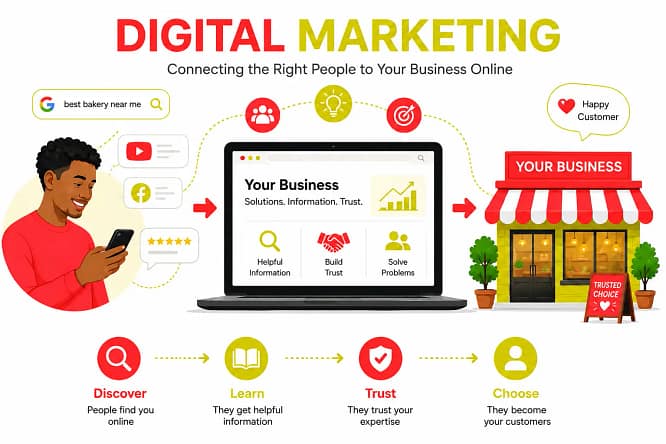
This picture defines what digital marketing is about
Now that you know why digital marketing matters, let's understand why digital marketing is so important to you and why you should take it seriously.
If you ask different people about digital marketing, you'll probably get different answers.
Some will tell you digital marketing is all about posting on Facebook or running Instagram Ads.
Others will say it's running Google Ads or creating videos for TikTok.
While all of these are part of digital marketing, none of them tells the full story.
Digital marketing is simply the process of using the internet and digital platforms to connect your business with people who need what you offer.
Its purpose is not just to make sales. Its main purpose is to help the right people discover your business, understand what you do, trust you, and eventually become your customers.
Think about your own life for a moment.
The last time you wanted to buy a phone, book a hotel, find a good restaurant, repair your car, or even look for a school, where did you start?
I'm not a prophet, but I can tell you searched on Google or YouTube for solutions.
Or perhaps you read customer reviews on Google or comments under a post on social media.
You know that before you even spend money to buy something, you wanted information that would help you make the right decision.
That is exactly how most buying decisions happen today.
Long before people contact your business, they are already searching, comparing, and learning online.
If your business appears during that journey, you have a chance to earn their trust.
If it doesn't, your competitors will probably get the opportunity instead.
Imagine you own the best bakery in your town. Every loaf of bread is fresh, your cakes taste so good, and your customers love your service.
The only problem is that your bakery is hidden on a street that nobody knows about.
No signs point people in your direction, and nobody talks about your business.
Even though your bread tastes so good, very few people will ever discover it.
Now imagine another bakery that isn't necessarily better than yours but is located on a busy road where thousands of people pass every day.
It also has clear signboards, good directions on Google Maps, an active Facebook page, and positive customer reviews.
Which bakery is likely to attract more customers?
I'm sure you would choose the second one, not because it offers better products, but because it is easier to find and easier to trust.
The internet works in much the same way.
Having a great product or service is important, but it is only part of the equation.
People cannot buy from a business they don't know exists.
Before people can become your customers, they have to find you. And digital marketing makes that possible.
It helps your business appear where someone is already spending their time.
It helps you answer their questions before they even contact you. It gives them confidence that you're the right person to solve their problem.
This is why digital marketing is much more than advertising.
Advertising is only one piece of a much bigger picture.
Digital marketing begins with understanding people.
What are they looking for? What problems are they trying to solve?
What information do they need before they feel comfortable making a decision?
When you can consistently answer those questions, you stop chasing customers.
Instead, you become the business that customers naturally discover when they need help.
That is what digital marketing is all about. It isn't about convincing people to buy things they don't need.
It's about making it easy for the people who already need your product or service to find you, learn from you, and trust you enough to choose you over everyone else.

I've learned that most businesses don't have a customer problem... they have a visibility problem.
awuah gideon
Why Is Digital Marketing Important?
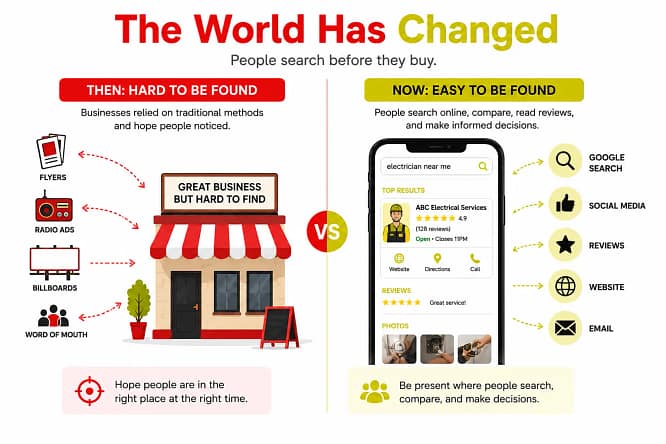
Why is digital marketing important for your business?
Not too long ago, growing a business in Ghana was very different from what it is today.
If you wanted more customers, you might print flyers and hand them out on the street.
You could pay for a radio advertisement, which cost more than GHC4000, put up a billboard, or rely on people to recommend your business to their friends and family.
These methods still work in some situations, but they all have one thing in common: they depend on people being in the right place at the right time.
Today, the world has changed.
Before people visit a shop, they often visit Google. Before they call a business, they check its website or social media page.
Before they spend their money, they read reviews, compare prices, and look for proof that they are making the right decision.
The internet has become the first place people go when they need answers.
This is why digital marketing is no longer something that only large companies need.
It has become important for every business, whether you own a small shop at Kantamanto, run a restaurant in East Legon, sell clothes on TikTok, offer professional services, or are just starting a side hustle from home.
Imagine two electricians who provide the same quality of work.
The first electrician only waits for people to hear about him through word of mouth.
The second electrician has a simple website, appears in Google search results when someone searches for "electrician near me," shares helpful tips on Facebook, and has positive customer reviews online.
Both are skilled. Both charge similar prices.
Both genuinely care about their customers.
But when someone's power goes out at 10 p.m., and they search online for an electrician, which one are they more likely to call?
The answer is obvious.
The business that can be found usually gets the first opportunity.
That doesn't mean digital marketing replaces good products or excellent customer service.
In fact, it depends on them. Digital marketing may bring people to your business. Still, only a good customer experience will keep them coming back and encourage them to tell others about you.
Another reason digital marketing is so important is that it helps businesses compete on a level playing field.
Years ago, the biggest companies had a huge advantage because they could afford expensive television commercials, newspaper advertisements, and giant billboards.
Small businesses often couldn't compete because they didn't have the same budget.
The internet changed that.
Today, a small business with a valuable website, useful content, and a smart digital marketing strategy can compete with businesses that have been around for years.
It won't happen overnight, but it is possible. Every day, people choose businesses not because they are the biggest, but because they answer their questions, earn their trust, and are easy to find.
Digital marketing is also valuable because it helps you build relationships, not just make sales.
Think about the businesses you trust the most. Chances are, you didn't trust them the first time you heard their name.
You probably saw them several times. Maybe you read one of their articles, watched a video they shared on TikTok, followed them, or received helpful emails from them.
Over time, your confidence in them grew.
That is exactly how trust works.
People usually don't buy from strangers, especially when they have many options.
They buy from businesses that consistently show up, deliver value, and demonstrate an understanding of their customers' problems.
This is why digital marketing is much more than promoting products. It is about building trust at every stage of the customer's journey.
As you continue reading this guide, you'll discover that digital marketing is made up of several different strategies.
Some help people find your business through search engines like Google.
Others help you connect with customers through social media, email, or online advertising.
Each one has a different purpose, but they all work together toward the same goal: helping the right people discover your business, trust your brand, and become loyal customers.
People don't trust a business because they see it once. They trust it because it keeps showing up with value.
How Does Digital Marketing Work?
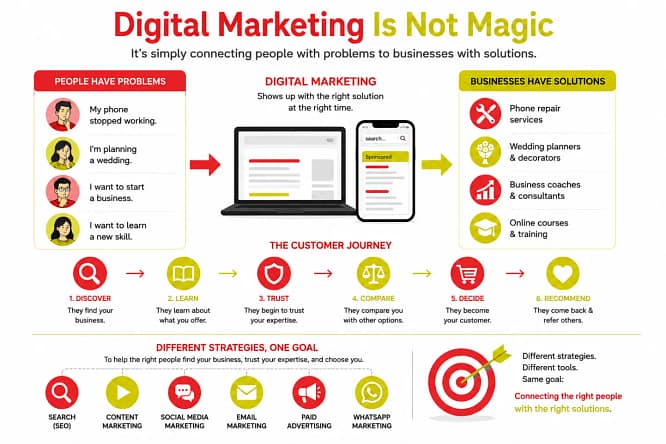
How does digital marketing works
At first, digital marketing can seem like a technical thing only for IT guys...
You see businesses getting customers through Google, Facebook, Instagram, YouTube, email, and even WhatsApp.
It almost looks complicated when you don't really understand how it works.
But once you understand what happens behind the scenes, you'll realize there is nothing magical about it at all.
Digital marketing works by connecting people with problems to businesses that have solutions.
It really is that simple.
Think about it from your own experience. Whenever you have a problem, your first instinct is usually to look for an answer.
If your phone suddenly stops working, you search for a repair shop.
If you're planning a wedding, you look for decorators or caterers. If you're thinking of starting a business, you search for information that can help you get started.
Every search begins with a problem.
Behind every purchase is a person trying to solve something.
A hungry person looks for food. A parent looks for a good school. A business owner looks for more customers.
A student looks for a course that will help them build new skills.
People don't wake up wanting to see advertisements. They wake up wanting solutions.
This is where digital marketing comes in.
Instead of waiting and hoping that customers will somehow discover your business, digital marketing helps your business appear when people are already searching for answers.
It allows you to meet potential customers at the exact moment they need your help.
But finding your business is only the first step.
Imagine you search online for a company that repairs laptops. You click on two different websites.
The first one loads quickly, clearly explains its services, shows customer reviews, and provides an easy way to get in touch.
The second website is slow, confusing, and hasn't been updated for years.
Even if both businesses offer the same quality of service, which one would you trust?
I know you'll choose the first one, right?
That is because digital marketing isn't only about attracting visitors.
It's also about building confidence. Every piece of information someone sees about your business either increases their trust or makes them leave.
This is why successful digital marketing focuses on the entire customer journey, not just getting clicks.
A visitor first discovers your business, then learns about what you offer, begins to trust you, compares you with other options, and finally decides whether to become your customer.
Even after they make a purchase, the journey doesn't end. If they have a great experience, they may come back and recommend your business to others.
Think of digital marketing as planting a seed.
You don't put a seed into the ground and expect a tree to appear the next morning. You water it, protect it, and give it time to grow. Eventually, it produces fruit.
The same principle applies to marketing.
Every helpful article you publish, every useful video you create, every positive review you earn, and every satisfied customer you serve is another seed you plant.
Some seeds grow quickly, while others take longer.
Over time, however, they all work together to build a business that people know, trust, and recommend.
This is one of the biggest mistakes many business owners make.
They think digital marketing is about getting instant sales...
Sometimes it can produce quick wins, especially with paid advertising.
Still, the most successful businesses understand that lasting growth comes from consistently showing up, providing value, and earning trust.
As you'll discover throughout this guide, digital marketing isn't one single activity.
It is made up of different strategies that work together.
Some strategies help people discover your business through search engines.
Others help you educate your audience with valuable content.
Some allow you to stay connected through email.
In contrast, others help you reach new customers through social media or paid advertising.
Each strategy has a different job, but they all share the same goal.
To help the right people find your business, trust your expertise, and confidently choose you when they are ready to buy.
Digital marketing works best when you stop chasing customers and start helping them make better decisions.
The Main Types of Digital Marketing
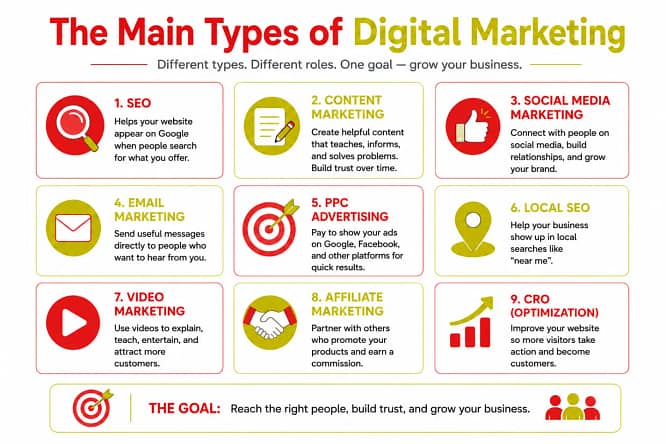
What are the main types of digital marketing
By now, you've probably realized that digital marketing is much bigger than posting on social media or running online advertisements.
In fact, digital marketing comprises several strategies.
Think of digital marketing like building a house.
You don't build a house using only bricks. You need cement, roofing sheets, windows, doors, plumbing, electrical wiring, and many other materials.
Each one plays a different role, but together they create a home that is strong, safe, and comfortable.
Digital marketing works in much the same way.
No single strategy can do everything on its own.
The businesses that grow consistently are usually the ones that combine several digital marketing strategies instead of relying on just one.
Let's look at the most important ones.
Search Engine Optimization (SEO)
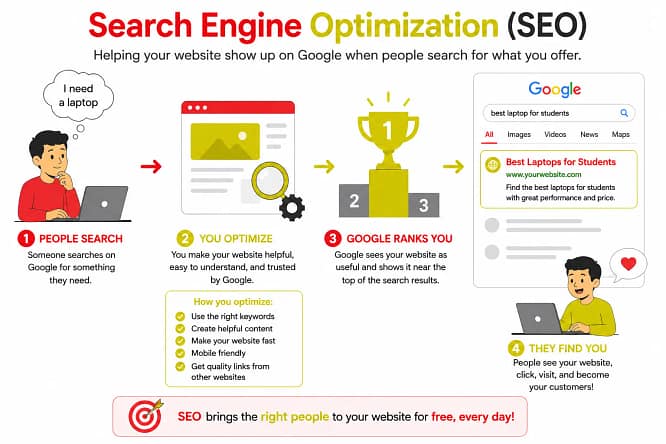
What is Search Engine Optimization (SEO)?
Have you ever searched for something on Google and clicked one of the first results you saw?
That is exactly what Search Engine Optimization, or SEO, is all about.
SEO is the process of helping your website appear in search engine results when people are looking for information, products, or services like yours.
Instead of paying for every visitor, SEO focuses on earning visibility naturally by creating useful content and making your website easy for search engines to understand.
If someone in Ghana searches for "best digital marketing agency" or "website designer near me," SEO helps your business appear among the options they discover.
We'll cover SEO in much more detail in our complete Search Engine Optimization (SEO) Guide.
Content Marketing
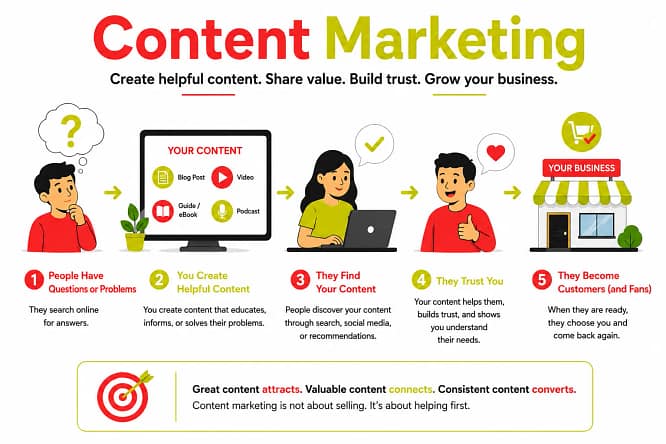
What is Content Marketing
Imagine walking into a shop where the owner happily answers all your questions without pressuring you to buy anything.
You would probably trust that business more than one that immediately tries to sell you something.
Is that correct?
Content marketing works the same way.
Instead of constantly promoting your products or services, you create valuable content that educates, informs, or solves problems for your audience.
This could be blog posts, YouTube videos, guides, podcasts, or even simple social media posts.
When you consistently help people, they begin to see you as an expert.
And when they are finally ready to buy, they are much more likely to choose the business that has already earned their trust.
Social Media Marketing
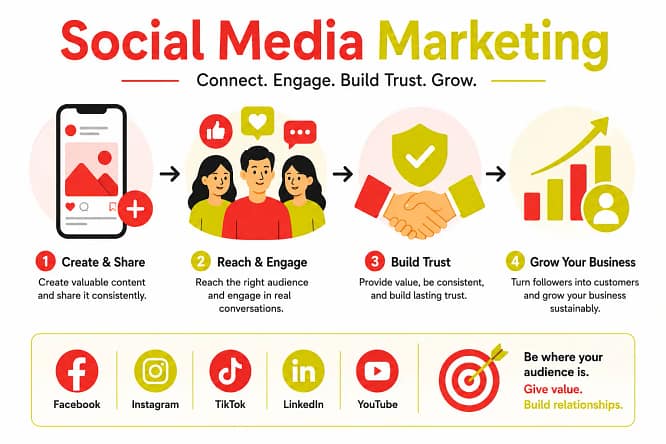
What is Social media marketing?
Millions of people spend hours every day on platforms like Facebook, Instagram, LinkedIn, TikTok, and X.
Social media marketing helps businesses meet customers where they already spend their time.
It allows you to build relationships, answer questions, share updates, and create a community around your brand.
Many people think social media is only about getting likes and followers.
In reality, its greatest value is helping businesses stay connected with the people they serve.
Email Marketing
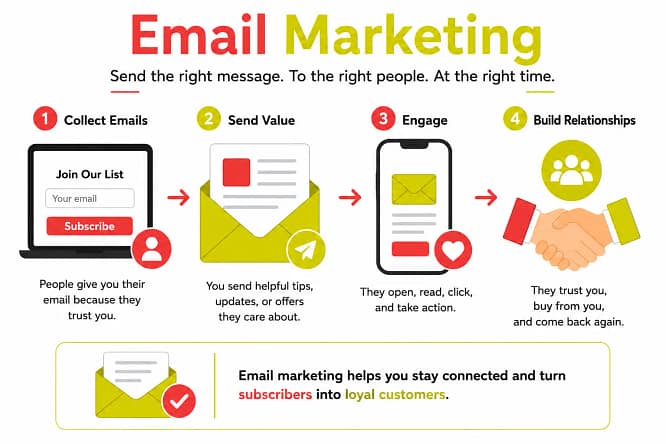
What is Email Marketing?
Some people believe email marketing is outdated, but nothing could be further from the truth.
Email remains one of the most effective ways to communicate directly with your audience.
Unlike social media, where algorithms decide who sees your content, email allows you to speak directly to people who have chosen to hear from you.
Whether you're sharing helpful tips, announcing a new product, or offering a special promotion, email helps you stay connected long after someone leaves your website.
Pay-Per-Click (PPC) Advertising
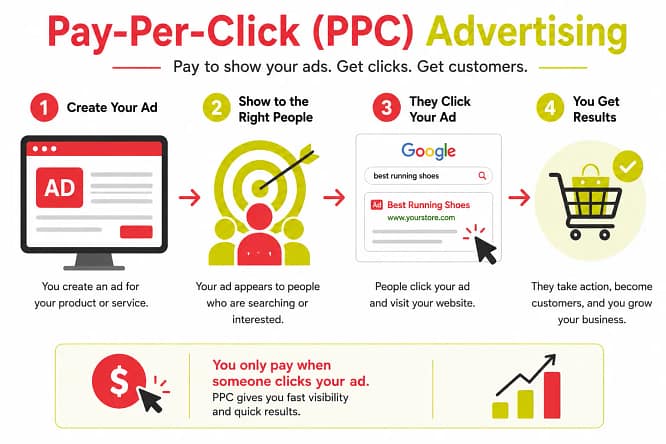
What is Pay-Per-Click (PPC) Advertising
Sometimes you don't want to wait months for your business to appear in search results.
That's where paid advertising comes in.
Platforms like Google Ads and Facebook Ads allow businesses to pay for extra visibility.
Instead of waiting for people to find you naturally, you can place your business in front of the right audience almost immediately.
Paid advertising can deliver fast results, but it works best when combined with other digital marketing strategies rather than replacing them.
Local SEO
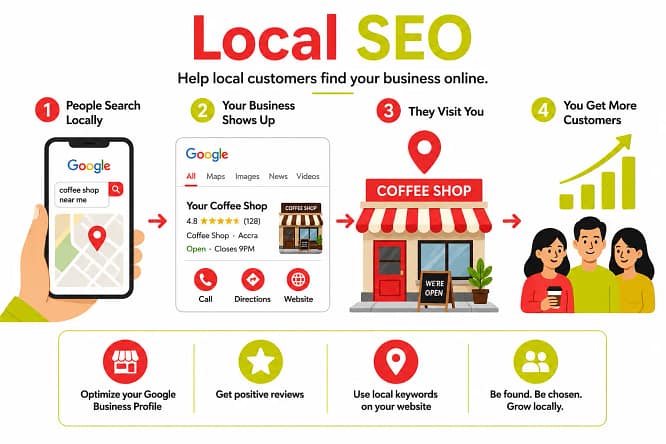
What is Local SEO
Not every business wants customers from all over the world.
A barber in Kumasi wants customers from around Kumasi. A restaurant in Accra wants people nearby to discover its menu. A dentist in Takoradi wants local patients.
Local SEO helps businesses appear when people search for products or services in a specific location.
If you've ever searched for "restaurant near me" or "pharmacy near me," you've already seen Local SEO in action.
For businesses that serve a local community, this can be one of the most valuable digital marketing strategies available.
Video Marketing
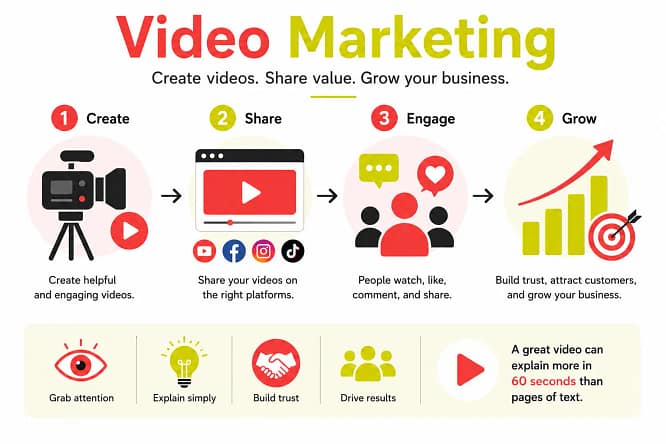
What is What is Video Marketing
People love watching videos because they are easy to understand and often more engaging than reading long blocks of text.
Businesses use videos to explain products, answer common questions, tell customer stories, and demonstrate how something works.
Platforms like YouTube, TikTok, Instagram Reels, and Facebook have made video one of the fastest-growing forms of digital marketing.
Sometimes, a 60-second video can explain what would take several pages to write.
Affiliate Marketing
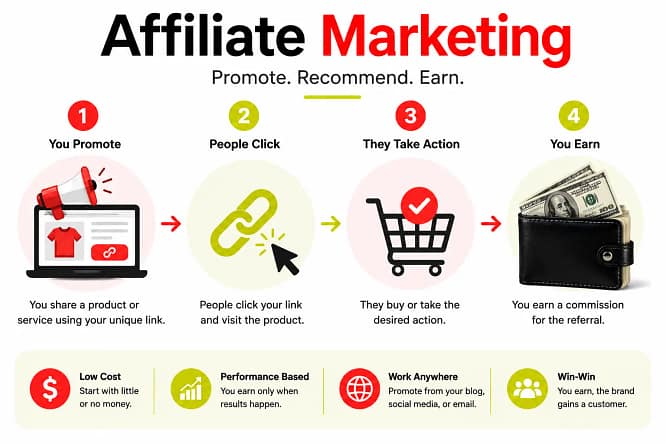
What is affiliate marketing
Affiliate marketing is a partnership.
Instead of promoting your own products, other people recommend them to their audience.
When someone purchases their recommendation, the affiliate earns a commission.
This strategy allows businesses to reach new customers while rewarding people who help spread the word.
Conversion Rate Optimization (CRO)
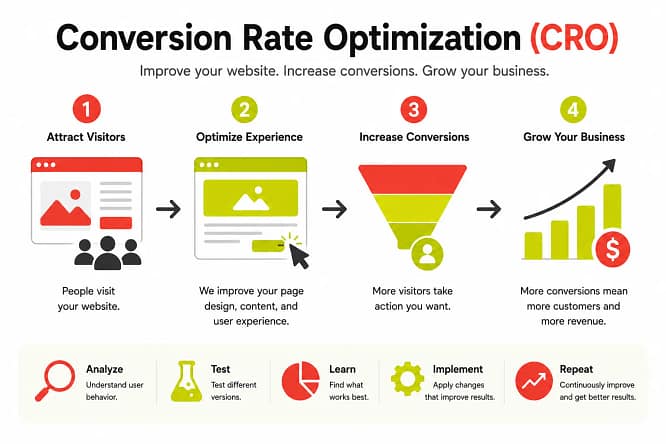
What is Conversion Rate Optimization (CRO)
Getting people to visit your website is only half the battle.
The next challenge is helping them take action.
Conversion Rate Optimization, often called CRO, focuses on improving your website so that more visitors become customers.
Sometimes, small changes like clearer headlines, faster-loading pages, or a simpler contact form can make a surprisingly big difference.
The goal isn't just to attract more traffic. It's to make better use of the traffic you already have.
As you can see, digital marketing isn't a single skill.
It's a collection of strategies that work together toward one common goal: helping businesses reach the right people, build trust, and grow sustainably.
The good news is that you don't have to master all of them at once.
Every successful business starts somewhere.
As you continue reading this guide, you'll discover how these different strategies fit together and how to choose the ones that make the most sense for your business.
The best marketers don't try to be everywhere. They choose the right channels for the right people at the right time.
How to Create a Digital Marketing Strategy
What is the best digital marketing strategy
If someone asked me to help grow their business today, I wouldn't start by looking at their website.
I wouldn't ask how many followers they have on social media, and I certainly wouldn't begin by recommending Facebook Ads or Google Ads.
Those things matter, but they don't tell me whether the business has a strategy.
They only tell me what the business is doing.
There's an important difference between having marketing activities and having a marketing strategy.
I've seen businesses publish content every day, spend thousands on advertising, and stay active on every social media platform you can think of.
From the outside, they look busy. They look like they're doing everything right.
Yet when you ask them why they're doing those things or what results they're expecting, the answers are often vague.
They're marketing because they know they should market, not because every activity is connected to a clear purpose.
To me, that's like setting out on a journey without deciding where you're going.
You can keep driving for hours, but movement isn't the same as progress.
Unless you know your destination, every road looks like the right one until you realize you've ended up somewhere you never intended to be.
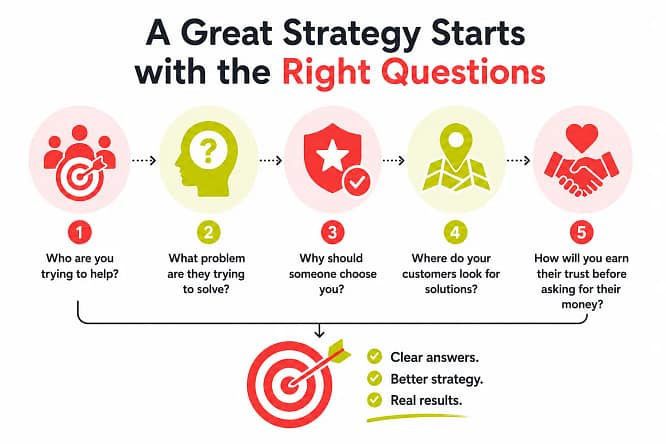
That's why I believe every digital marketing strategy should begin with questions, not answers.
Before you think about websites, search engines, advertisements, or content, I encourage you to sit down with a notebook and answer a few simple questions about your business.
Don't rush through them. These questions will shape every marketing decision you make from this point forward, and the clearer your answers are, the easier the rest of your strategy becomes.
The first question is simple.
Who are you trying to help?
Most business owners answer this question by describing their product. I think that's the wrong place to begin.
Your strategy shouldn't start with what you sell; it should start with the people you want to serve.
Let's imagine you own a bakery in Accra. You might say, "I sell cakes and pastries."
That's true, but it doesn't tell me who you're trying to help.
Are you serving busy professionals looking for breakfast before work?
Parents ordering birthday cakes for their children? Couples planning weddings? Corporate organizations looking for event catering?
Those are completely different customers. They have different needs, different budgets, different concerns, and they look for businesses in different ways.
If you try to speak to all of them with the same message, you'll probably connect with none of them in a meaningful way.
The clearer you become about the people you want to help, the easier every marketing decision becomes.
You begin creating content that speaks directly to their situation, rather than hoping that something you say will resonate with everyone.
Once you know who you're trying to help, the next question becomes even more important.
What problem are they trying to solve?
This is one of the biggest mindset shifts I've experienced in marketing.
People don't usually go online looking for products. They go online looking for solutions.
Someone searching for an accountant isn't really looking for accounting services.
They're looking for someone who can remove the stress of managing their finances.
Someone searching for a plumber isn't interested in pipes. They're trying to stop water from flooding their home.
A business owner searching for digital marketing isn't looking for SEO or Facebook Ads.
They're looking for more customers, more enquiries, and more sales.
When you understand the real problem behind the search, your marketing changes completely.
Instead of talking endlessly about your services, you begin talking about the challenges your customers face every day.
That's the kind of marketing people pay attention to because it feels relevant to their lives.
The third question I always ask is one that many businesses overlook.
Why should someone choose you?
I'm not asking why you're better than your competitors. I'm asking what makes your business the right choice for the people you want to serve.
Perhaps you respond faster than anyone else. Maybe you've spent years working in a particular industry.
Perhaps your process is simpler, your communication is clearer, or your experience allows you to solve problems others struggle with.
Whatever your answer is, it should be rooted in something real. Customers are becoming increasingly good at recognizing empty marketing claims.
Simply saying you're "the best" or that you offer "quality service" no longer builds trust, because every business says the same thing.
Trust is built when people see evidence, not slogans.
After you've answered those questions, I want you to think about something practical.
Where do your customers go when they start looking for a solution?
This is where many people mistakenly begin their marketing strategy, but notice that we've arrived here only after understanding the customer.
Some businesses need to appear in Google Search because that's where their customers begin their research.
Others rely heavily on social media because that's where conversations are already happening.
Some audiences spend hours watching educational videos before making a decision. In contrast, others depend on recommendations from friends, customer reviews, or local business listings.
The point isn't to be everywhere.
The point is to be present where your customers are already looking.
When you understand their behaviour, choosing the right marketing channels becomes much easier because your decisions are based on evidence rather than trends.
Finally, I ask what I believe is the most important question of all.
How will you earn their trust before asking for their money?
This is where many marketing strategies fail.
Businesses spend so much time trying to make a sale that they forget trust usually comes first.
Think about your own behaviour. If you're about to spend a significant amount of money, you probably don't buy from the first business you discover.
You read reviews. You compare options. You visit websites. You ask questions. You watch videos. You look for signs that the business understands what it claims to understand.
Your customers do the same thing.
Every helpful blog post you publish, every educational video you create, every customer success story you share, every useful email you send, and every honest conversation you have is building trust long before anyone reaches your checkout page.
When people trust you, selling becomes much easier because you're no longer convincing strangers.
You're helping people make informed decisions.
As you answer these questions, something interesting begins to happen.
Your strategy starts writing itself.
You know who you're trying to help.
You understand the problem your target customers are trying to solve.
You know why your business is the right fit.
You know where they're looking for answers.
And you know how you're going to earn their trust before asking them to become customers.
Everything else becomes execution.
Your SEO strategy helps people discover you on Google.
Your content marketing educates them. Your social media keeps your business visible.
Your email marketing continues the conversation. Your website gives them confidence to take the next step.
None of these things are the strategy. They're simply the tools you use to carry it out.
That's why I don't believe a digital marketing strategy starts with choosing marketing channels.
I believe it starts with understanding people.
Once you understand people, the rest of marketing becomes much easier because every decision has a clear purpose.
You're no longer copying what another business is doing or chasing the latest marketing trend.
You're building a system that helps your ideal customers solve their problems, and that's the kind of strategy that continues to work even as technology, platforms, and algorithms change.
Stop asking, "What marketing strategy should I use?" Start asking, "What would genuinely help my customer?" That's where the best marketing begins.
Awuah Gideon ● Digital Marketer Strategist
Understanding the Customer Journey
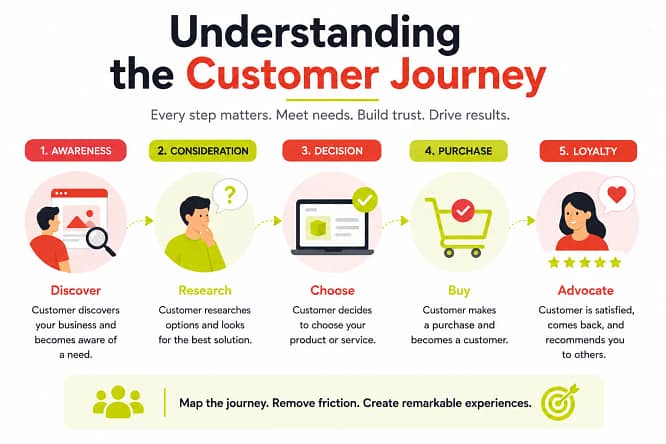
Understanding the Customer Journey
One of the first questions I ask whenever I look at a business's marketing is surprisingly simple: Where is your customer right now?
I don't mean where you want them to be. I mean where they actually are.
Most business owners never stop to think about that difference. They know exactly what they want people to do.
They want visitors to buy a product, book a consultation, request a quote, or send a WhatsApp message.
Yet very few stop to ask whether the customer is even ready to take that step.
Over the years, I've learned that this is where many marketing problems begin.
Imagine that two people visit your website today.
The first person has only just discovered they have a problem.
They're curious, but they know very little about you and are simply looking for answers.
The second person has been reading your blog for weeks.
They've watched your videos, compared you with other businesses, and they're almost ready to make a decision.
Now ask yourself an honest question. Should both people receive the same message?
Take your time to think about it...
I don't think they should, because they're not in the same place.
The first visitor doesn't need a discount or a sales pitch. They need clarity.
They need someone to explain the problem they're facing and help them understand what to do next.
The second visitor needs something completely different.
They already understand the problem and have probably narrowed their options. What they're looking for now is confidence.
They want reassurance that choosing your business is the right decision.
Unfortunately, many businesses speak to both people as though they're the same person.
It's like a teacher walking into a classroom where some students are seeing the subject for the first time while others are preparing for their final exam, and then teaching the same lesson to everyone.
Beginners struggle to keep up, advanced students lose interest, and very few people leave with what they actually need.
That's why I believe the customer journey is one of the most important ideas in digital marketing.
At its heart, it's simply a reminder that people need different things at different moments.
Someone who's only beginning to understand their problem needs education.
Someone who's comparing different solutions needs guidance.
Someone who's almost ready to buy needs confidence, while someone who has already become your customer needs an experience that makes them want to stay.
The journey changes, and your marketing should change with it.
Once I understood this, the way I looked at content completely changed.
I stopped expecting one blog post, one Facebook update, or one email to do everything.
I see businesses make this mistake all the time.
They publish a single piece of content and expect it to attract new people, explain the problem, build trust, answer objections, convince people to buy, and create loyal customers.
That's asking one piece of content to carry the weight of an entire marketing system, and it rarely works.
Instead, I started thinking differently.
Every piece of marketing should have one clear purpose.
Sometimes its job is to help someone discover that a solution exists.
Sometimes it's there to answer a question that's been holding them back.
Sometimes it removes a fear that's stopping them from making a decision.
Other times, its only job is to remind people that you're still there when they're ready.
Each interaction doesn't have to complete the journey. It only needs to help the customer take the next step.
That single idea changed the questions I ask before creating anything.
Years ago, I would sit down and ask myself, "What should I post today?" Now I ask a very different question: "Who am I talking to today?"
Am I speaking to someone who's just discovered my business? Someone who's comparing different options?
Or someone who's already convinced but needs one final reason to move forward?
The answer shapes almost everything I create, from the articles I write and the videos I record to the emails I send and even the way I organise a website.
It also changed the way I think about marketing channels.
People often ask me which one is the best. Is it SEO, social media, email marketing, or Google Ads?
I don't think there's a single best channel because I don't think they all have the same job.
Asking which channel is best is like asking whether a hammer is better than a screwdriver. The answer depends entirely on what you're trying to build.
The same is true in digital marketing.
Someone searching on Google is usually looking for answers.
Someone reading your emails already knows who you are.
Someone visiting your pricing page is much closer to deciding than someone watching your first YouTube video.
Each channel supports a different part of the customer's journey. Once you understand that, you stop copying what other businesses are doing because you realise they're probably speaking to customers at a completely different stage.
Looking back, this is one lesson I wish I had learned much earlier. I used to believe that successful marketing meant being everywhere.
Today, I believe it means meeting people where they are.
There's an important difference between those two ideas. Being everywhere might make your business visible, but meeting people where they are is what makes your business valuable.
To me, that's what the customer journey has always been about.
It's not just another marketing framework or a diagram you'll find in a textbook. It's a way of thinking.
It reminds me that every customer is moving at their own pace, and my job isn't to push them to the finish line before they're ready.
My job is to help them take the next step. When I do that consistently, strangers become visitors, visitors become customers, and customers become loyal supporters who introduce my business to someone new.
Then the journey begins again.
Creating Content That Builds Trust
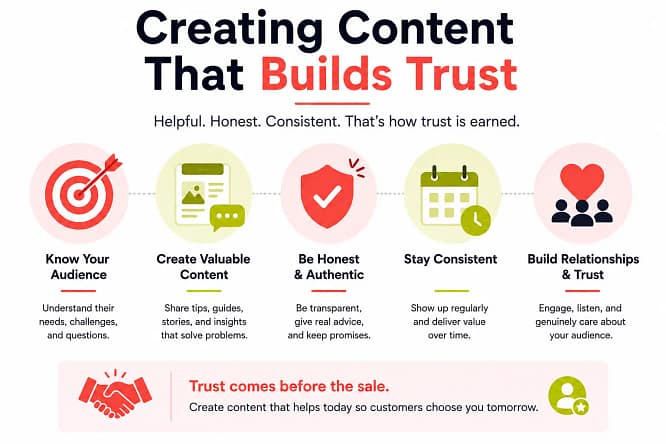
How to create content that builds trust
One of the biggest misunderstandings I see in digital marketing is the way people think about content.
Many businesses treat it as another task on their to-do list.
They wake up in the morning wondering what to post on Facebook, what picture to upload to Instagram, or what video to record for TikTok.
By the end of the day, they've published something, but very little has changed.
The post disappears into the endless stream of content online, and they wonder why their marketing isn't working.
I don't think the problem is that they're creating content.
I think the problem is that they're creating content without understanding its purpose.
For me, content has never been about staying active on social media or proving that my business exists.
It's about helping another human being.
Every article I write, every video I record, and every email I send has one simple purpose: to leave someone knowing a little more than they did before they found me.
That may not sound like much, but I've learned that small moments of understanding can change the way people see a business.
Think about the last time you searched for an answer online.
Maybe something in your house stopped working. Maybe you wanted to learn a new skill.
Maybe you were trying to solve a problem at work.
You found an article or watched a video that explained everything in simple language. By the time you finished, you felt more confident than you did a few minutes earlier.
Chances are, you remembered the person who helped you.
Not because they asked you to.
Because they earned it.
That's the quiet power of good content.
It doesn't force people to trust you. It gives them a reason to.
I've noticed something interesting over the years.
The businesses people trust the most aren't always the ones with the biggest advertising budgets.
Very often, they're the businesses that have answered hundreds of questions before asking for a sale.
Every helpful guide, every honest explanation, and every practical example becomes another small promise that says,
"If we care this much before you become our customer, imagine how we'll treat you after you do."
Trust isn't built in one big moment.
It grows through many small moments.
That's why I don't measure the success of a piece of content by asking whether it generated a sale today.
I ask a different question.
Did it help someone?
If the answer is yes, then the content has already done something valuable.
Maybe the reader isn't ready to buy today.
That's perfectly fine. People remember businesses that make their lives easier.
When the day finally comes that they need your product or service, they'll often remember the business that taught them something rather than the one that kept interrupting them with advertisements.
This is also why I believe education is one of the most powerful forms of marketing.
When you teach someone how to solve a problem, you're demonstrating your knowledge instead of simply claiming to be an expert.
Anyone can write on their website that they're experienced or professional.
Those are just words. Actual expertise is shown by explaining difficult ideas in a way that ordinary people can understand.
I've always believed that if you can't explain something, you probably don't understand it well enough yourself.
That's one reason I write the way I do.
I don't want readers to leave impressed by complicated words.
I want them to leave with confidence. If a grandmother can understand an article and a business owner can still learn something valuable from it, then I know I've done my job.
There's another reason content matters that many people overlook.
Unlike an advertisement, helpful content doesn't disappear the moment your budget runs out.
A useful blog post can answer questions for years. A well-made video can teach thousands of people while you're asleep.
A detailed guide can introduce your business to someone on the other side of the world who has never heard your name before.
In other words, good content keeps working long after you've finished creating it.
That's why I don't see content as an expense.
I see it as an asset.
Every helpful article becomes another doorway into your business.
Every useful video becomes another conversation with someone who needs your help.
Every answer you publish becomes another reason for people to trust you.
Over time, those small pieces of trust begin to accumulate.
One article leads to another. One video leads to another. One email leads to another.
Before long, people stop feeling like strangers. They begin to feel familiar with your business, and familiarity is often the first step toward trust.
That's why I don't think the goal of content is to go viral.
The goal is to become valuable.
Viral content can make thousands of people notice you for a day.
Valuable content can make people remember you for years.
If you remember only one idea from this piece, let it be this:
Don't create content to fill your website or your social media pages.
Create content to leave people better informed, more confident, or more capable than they were before they found you.
When you consistently help people without expecting an immediate return, something remarkable happens.
Trust stops being something you ask for.
It becomes something you earn.
Choosing the Right Digital Marketing Channels
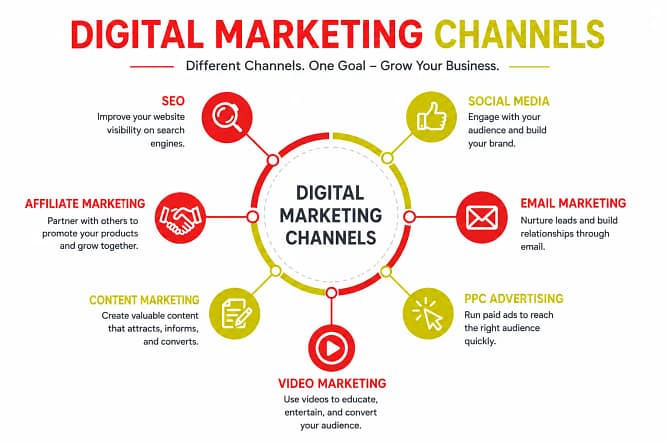
What are the top digital marketing channels?
One of the questions I hear more than almost any other is...
"Which digital marketing channel is the best?"
People want to know whether they should focus on Facebook, Instagram, TikTok, LinkedIn, YouTube, Google, email marketing, or paid advertising.
They hope there's one platform that will solve all their marketing problems.
I don't think there is.
Over the years, I've learned that asking which channel is best is a little like asking whether a bus, a bicycle, or an airplane is the best way to travel.
I can't answer that until I know where you're trying to go.
A bicycle is perfect for a short trip around your neighbourhood. Still, it's a terrible choice if you're travelling across the country.
The vehicle isn't the problem. The destination decides which one makes sense.
I believe digital marketing works the same way.
The right channel depends on the people you're trying to reach, the problems they're trying to solve, and the way they naturally look for information.
Before I choose a platform, I always try to understand my audience.
Where do they spend their time? What questions are they asking? When they need help, what do they do first?
Those questions are much more important than asking which platform is currently popular.
I've watched businesses abandon one platform because another one was trending.
One year everyone rushes to Facebook. Then Instagram becomes the answer. After that it's TikTok. Then everyone starts talking about LinkedIn or YouTube.
Businesses spend so much time chasing trends that they never stop to ask whether their customers moved there too.
Your customers don't wake up each morning thinking about marketing channels.
They're thinking about their own lives.
They're thinking about finding a reliable plumber before the pipes burst.
They're trying to choose the right school for their children.
They're searching for a better accounting system for their business. They're looking for answers, not platforms.
That's why I think businesses should stop chasing channels and start following customers.
If your customers search Google before making a decision, then search engine optimisation and helpful articles deserve your attention.
If they spend hours watching videos to learn new skills, YouTube might become one of your strongest channels.
If they already know your business and need regular updates, email may become far more valuable than another social media account.
Notice what's happening here.
The customer is choosing the channel.
You're simply deciding to meet them there.
That small shift in thinking can save you time, money, and frustration.
Instead of trying to build a presence everywhere, you begin investing your energy where it has the greatest chance of making a difference.
I've also learned that every channel has its own job.
Search engines help people discover you when they're actively looking for answers.
Social media helps people become familiar with your business over time.
Email helps you continue conversations with people who have already invited you into their inbox.
Paid advertising can introduce your business to people who may never have discovered you on their own.
None of these channels is trying to replace the others. They're simply helping people in different ways.
This is why I don't believe successful digital marketing is about mastering every platform.
It's about mastering your customer.
The better you understand how people think, where they spend their time, and how they make decisions, the easier it becomes to choose the right channels.
Technology will continue to change. New platforms will appear. Old ones will become less popular. Algorithms will come and go.
Human behaviour, however, changes much more slowly.
People will always have questions.
People will always look for solutions.
People will always choose businesses they trust.
That's why I build my marketing around people first and platforms second.
If a new marketing channel appears tomorrow, I don't panic. I ask myself one question.
"Are my customers there, and does this platform help me serve them better?"
If the answer is yes, I'll learn it.
If the answer is no, I won't feel pressured to join simply because everyone else is talking about it.
I've found that this way of thinking removes a lot of unnecessary stress from marketing.
You no longer feel like you're falling behind every time a new platform becomes popular. Instead, you stay focused on the people who matter most, your customers.
In the end, choosing the right digital marketing channel isn't really about technology at all.
It's about understanding people.
When you know where your customers spend their time, how they search for answers, and what they expect from businesses like yours, identifying the right channels becomes much easier.
The platform is simply the bridge. The relationship is what really matters.
Measuring Digital Marketing Success
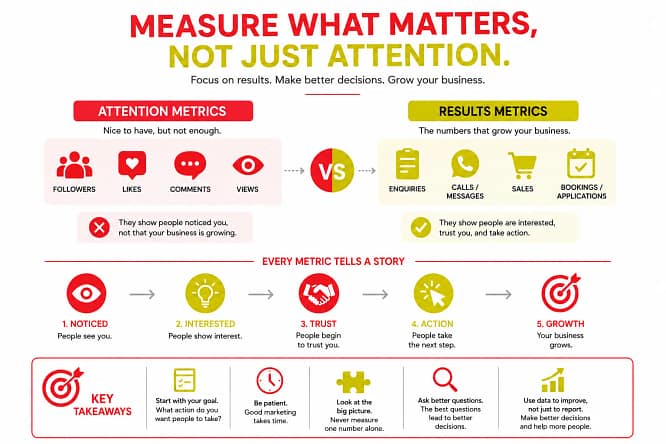
Measuring Digital Marketing Success
One of the easiest ways to become frustrated with digital marketing is to measure the wrong things.
I've met business owners who proudly tell me they have thousands of followers on social media, yet they're struggling to find customers.
Others celebrate that one of their videos reached hundreds of thousands of people.
Still, when I ask how many enquiries or sales it generated, they aren't sure.
That's when I realise they're measuring attention instead of results.
There's nothing wrong with having lots of followers, likes, comments, or video views.
Those numbers show that people are noticing your business. The problem begins when you mistake attention for success.
A crowded shop is exciting, but if nobody buys anything, the business still has a problem.
In the same way, a popular social media page doesn't automatically mean your marketing is working.
Over the years, I've learned that every number tells a story.
The important question isn't, "Is this number going up?"
The important question is, "What is this number trying to tell me?"
Imagine that more people are visiting your website than ever before, but very few of them contact you.
That isn't necessarily bad news. It may simply be telling you that people are interested, but they still have unanswered questions.
Perhaps your website isn't clear enough. Maybe your offer isn't convincing enough. Or maybe you're attracting the wrong audience altogether.
Now imagine the opposite situation. Your website receives fewer visitors than before, but enquiries and sales are increasing.
Many business owners would panic because traffic has dropped. I would probably be encouraged.
It could mean you're reaching fewer people, but the right people. Sometimes quality matters much more than quantity.
That's why I've stopped chasing numbers that only make me feel good.
Instead, I focus on numbers that help me make better decisions.
I like to think of digital marketing as a journey with small signs along the road.
Every metric is one of those signs. Some signs tell you that people have noticed you.
Others tell you they're becoming interested. Some tell you they're beginning to trust you.
The most important signs tell you they're taking action.
Those actions look different for every business.
For one business, success might mean someone filling out a contact form.
For another, it might be a phone call, a WhatsApp message, an online purchase, or someone booking an appointment.
A school might measure applications.
A charity might measure donations.
A content creator might measure newsletter subscribers.
The right measurement always depends on the goal you're trying to achieve.
That's why I encourage businesses to ask a simple question before launching any marketing campaign:
"What action do I want people to take?"
If you don't know the answer, you'll never know whether your marketing succeeded.
I've also learned that good marketing usually doesn't produce instant results.
Sometimes people read an article today, watch one of your videos next month, receive your email a few weeks later, and only then decide to contact you.
If you judge your marketing too quickly, you might stop doing the very things that would have worked if you'd simply given them more time.
That's especially true when you're creating helpful content.
Trust grows gradually. One helpful article may not change someone's mind.
Ten helpful articles just might. That's why consistency is often more valuable than chasing quick wins.
There's another lesson I've learned that has saved me from making poor decisions.
Never measure one number by itself.
Imagine your website traffic suddenly falls. At first, that sounds worrying. But what if enquiries remain the same? Or even increase?
Suddenly the picture looks very different. The numbers only make sense when they're viewed together, just as the pieces of a puzzle only make sense when you see the whole picture.
This is one reason I don't become too excited or too discouraged by a single week's results.
Marketing is built on patterns, not moments. One excellent day doesn't guarantee long-term success, and one disappointing week doesn't mean your strategy has failed.
The businesses that improve their marketing aren't usually the ones collecting the most data.
They're the ones asking the best questions.
What content keeps attracting visitors?
Where do people leave the website?
What questions do customers ask before buying?
Which pages encourage people to contact us?
Every answer helps you understand your customers a little better, and that's far more valuable than simply collecting numbers.
At the end of the day, the purpose of measurement isn't to impress anyone with a report full of graphs and percentages.
Its purpose is to help you make better decisions.
The numbers should help you understand what's working, what isn't, and where you can improve.
When you look at your marketing this way, data stops feeling intimidating. It becomes another tool for serving your customers more effectively.
If there's one lesson I'd like you to remember from this section, it's this:
Don't measure your marketing by how many people notice you. Measure it by how many people you help, how many people trust you, and how many people take the next step.
Those are the numbers that build businesses.
10 Common Digital Marketing Mistakes to Avoid
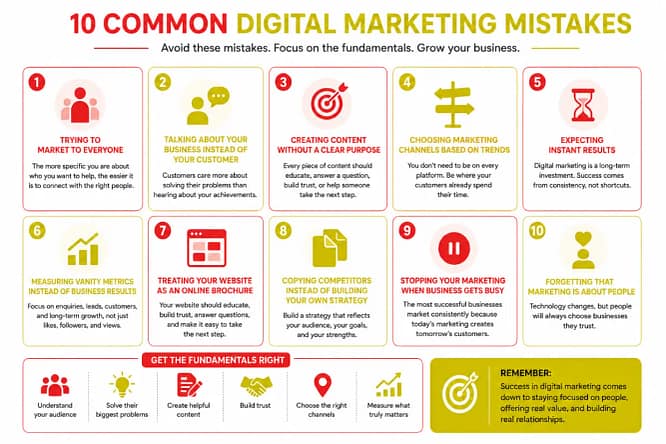
Digital Marketing Mistakes to Avoid
By now, you've learned that successful digital marketing isn't about finding the latest tricks, mastering every platform, or spending the biggest advertising budget.
More often than not, success comes from getting the fundamentals right.
The truth is, most businesses don't struggle because they lack ideas.
They struggle because they make the same mistakes over and over again.
Some of these mistakes seem small at first. Still, over time they quietly reduce trust, waste marketing budgets, and make it harder to attract the right customers.
Here are 10 common digital marketing mistakes to avoid.
1. Trying to Market to Everyone
One of the quickest ways to weaken your marketing is to believe everyone is your customer.
The more specific you are about who you want to help, the easier it becomes to create messages that connect with the right people.
2. Talking About Your Business Instead of Your Customer
Customers care more about solving their problems than hearing about your achievements.
The best marketing starts with their questions, challenges, and goals, not your products or services.
3. Creating Content Without a Clear Purpose
Sometimes, publishing content to stay active doesn't produce meaningful results.
Every blog post, video, email, or social media update should have a clear purpose, whether that's educating, answering a question, building trust, or helping someone take the next step.
4. Choosing Marketing Channels Based on Trends
You don't need to be on every platform. You need to be where your customers already spend their time.
Follow your audience, not the latest marketing trend.
5. Expecting Instant Results
Digital marketing is a long-term investment. Trust takes time to build, search rankings don't happen overnight, and meaningful relationships grow through consistency, not shortcuts.
6. Measuring Vanity Metrics Instead of Business Results
Likes, followers, and views can be encouraging, but they don't always grow a business.
Focus on the metrics that tell you whether your marketing is generating enquiries, leads, customers, and long-term growth.
7. Treating Your Website as an Online Brochure
Your website should do more than display information.
It should educate visitors, answer their questions, build confidence, and make it easy for them to take the next step.
8. Copying Competitors Instead of Building Your Own Strategy
It's fine to learn from successful businesses, but copying their tactics without understanding your own audience rarely leads to lasting success.
Build a strategy that reflects your customers, your goals, and your strengths.
9. Stopping Your Marketing When Business Gets Busy
Many businesses market themselves only when sales begin to slow.
The most successful businesses keep showing up consistently because they understand that today's marketing creates tomorrow's customers.
10. Forgetting That Marketing Is About People
Technology will continue to evolve. New platforms will emerge, algorithms will evolve, and AI will reshape how people discover information.
But one thing won't change: people still choose businesses they trust. Never let technology distract you from the people you're trying to serve.
Every mistake in this chapter has one thing in common.
A lack of technology or marketing tools is not the cause of any of them. They're caused by losing sight of the fundamentals.
If you remember the principles we've covered throughout this guide- understand your audience, solve their biggest problems, create helpful content, build trust, choose the right channels, and measure what truly matters- you'll avoid many of the mistakes that keep businesses from reaching their full potential.
10 Ways Digital Marketing Is Changing (and why you should care)
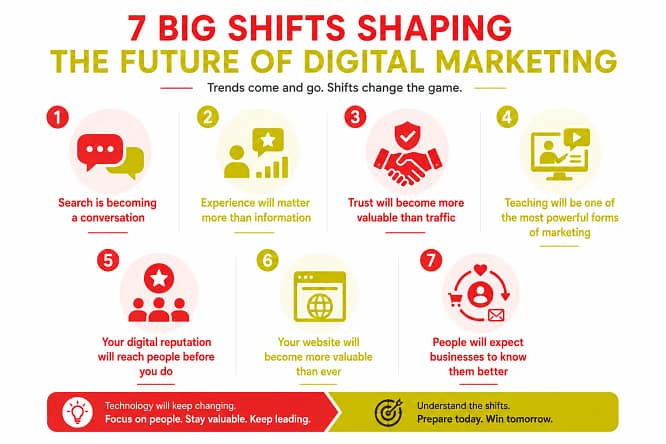
Future of Digital Marketing
If you had asked someone twenty years ago what digital marketing would look like today, I doubt they would have predicted search engines powered by artificial intelligence, videos watched by billions of people every day, or businesses selling products to customers they've never met in person.
Technology has changed at an incredible pace, and it will continue to change.
That can feel exciting, but it can also feel overwhelming.
Every year seems to bring a new platform, a new algorithm, or a new tool that promises to change marketing forever.
Over the years, I've learned not to worry too much about predicting the next big thing.
Instead, I try to understand the bigger shifts taking place beneath the surface.
Trends come and go, but shifts change the way people behave.
When you understand those shifts, you're far more prepared for the future, no matter which new technology comes along.
Here are ten changes I believe every business owner should understand.
1. Search Is Becoming a Conversation
For many years, people learned to search the internet by thinking like a search engine.
They typed a few keywords, pressed Enter, and hoped one of the results contained the answer they needed.
Today, that behaviour is changing.
Instead of typing a few words, people are asking complete questions using AI assistants and conversational search tools.
They're describing their situations in detail and expecting direct, helpful answers rather than a long list of websites.
That may sound like a small change, but it completely changes how businesses should think about content.
The future won't belong to businesses that repeat popular keywords.
It will belong to businesses that answer their customer's questions so clearly that both people and AI systems recognise them as reliable sources of information.
The question is no longer, "How do I rank for this keyword?"
It's becoming, "How do I become the best answer?"
2. Experience Will Matter More Than Information
There was a time when simply publishing information gave businesses an advantage.
Today, information is everywhere.
Artificial intelligence can generate articles in seconds, and customers can compare dozens of websites before making a decision.
As information becomes easier to produce, something else becomes more valuable.
Experience.
People want to learn from businesses that have actually solved problems, worked with customers like themselves, and learned lessons that can't be copied from someone else's website.
That's one reason I believe businesses should share more stories, more practical examples, and more honest lessons from their own journey.
Information teaches.
Experience builds confidence.
3. Trust Will Become More Valuable Than Traffic
For years, digital marketers celebrated website traffic.
More visitors often meant more success.
But I've noticed something interesting.
Some businesses attract thousands of visitors every month and still struggle to grow.
Others attract far fewer people but build loyal customers who recommend them to others.
The difference isn't usually traffic. It's trust.
As people become surrounded by endless information, they'll become more careful about who they believe.
Businesses that consistently educate, answer questions honestly, and demonstrate genuine expertise will have an advantage that advertising alone can't create.
Traffic may introduce someone to your business.
Trust gives them a reason to stay.
4. Teaching Will Become One of the Most Powerful Forms of Marketing
The internet has changed the way people buy.
Before speaking to a business, many customers have already watched videos, read reviews, compared prices, and asked AI tools for advice.
By the time they contact you, they've often done much of their homework.
That means businesses can no longer depend on sales messages alone.
They need to become teachers.
The businesses that explain complicated ideas, answer common questions, and help people make better decisions will naturally earn more trust than businesses that only talk about their products.
In the future, education won't just support marketing.
In many industries, it will be marketing.
5. Your Digital Reputation Will Reach People Before You Do
Years ago, your first impression happened when someone walked into your office or shop.
Today, your first impression often happens long before that.
People read your reviews.
They visit your website.
They watch your videos.
They ask AI assistants about your business.
They read what other customers have said.
By the time someone contacts you, they've already started forming an opinion.
Whether you realise it or not, your digital presence is speaking on your behalf every single day.
The question is whether it's telling the story you want people to hear.
6. Your Website Will Become More Valuable Than Ever
Social media has helped many businesses grow, but it also comes with a challenge.
You don't own it.
Algorithms change.
Rules change.
Platforms become popular and then slowly fade away.
Your website is different.
It's the one place online that belongs entirely to your business.
It's where your knowledge lives, where your content grows over time, and where you have complete control over the experience people have.
Businesses that continue to invest in helpful, well-organised websites will build an asset that becomes more valuable with every passing year.
7. People Will Expect Businesses to Know Them Better
Customers are becoming less interested in generic marketing.
They don't want messages written for everyone.
They want businesses that understand their industry, recognise their challenges, and speak directly to the problems they're trying to solve.
The businesses that take time to understand their customers will always communicate more effectively than those that simply broadcast the same message to everyone.
People don't expect businesses to know everything.
But they do expect businesses to understand them.
8. Continuous Learning Will Become a Business Advantage
One thing is almost certain.
Digital marketing five years from now won't look exactly like it does today.
New technologies will emerge.
Consumer behaviour will continue changing.
Artificial intelligence will become even more capable.
Businesses that treat learning as an ongoing habit won't fear those changes.
They'll adapt to them.
The future won't belong to businesses that know everything.
It will belong to businesses that never stop learning.
9. Attention Will Become Harder to Earn
Every day, people are exposed to thousands of advertisements, videos, emails, and social media posts.
The internet isn't running out of content.
It's running out of attention.
That means simply publishing more won't be enough.
Businesses that consistently create useful, memorable, and genuinely helpful content will have a much better chance of standing out than businesses producing content simply to stay active.
The future belongs to businesses that deserve attention, not those that demand it.
10. Helping People Will Never Go Out of Style
Whenever a new technology appears, people often wonder whether everything they know about marketing has become outdated.
I've never believed that.
The tools will continue changing.
Search engines will evolve.
Artificial intelligence will become smarter.
New platforms will replace old ones.
But behind every search, every click, every question, and every purchase is still a human being looking for help.
That hasn't changed.
And I don't believe it ever will.
Businesses that continue solving real problems, answering honest questions, and treating customers with respect will always have an advantage, regardless of what technology looks like in the future.
The future of digital marketing isn't really about technology.
It's about using technology to serve people better.
When I think about where digital marketing is heading, I don't feel worried.
I feel optimistic.
Every new technology creates new opportunities for businesses that are willing to learn, adapt, and continue helping people in meaningful ways.
If you've followed the ideas throughout this guide, you've probably noticed a pattern.
We've talked about understanding your audience.
Creating helpful content.
Building trust.
Choosing the right channels.
Measuring what matters.
Those ideas aren't becoming less important.
If anything, they're becoming even more valuable.
Technology will continue changing.
People won't.
And that's why I believe the businesses that put people first will continue to succeed, no matter what the future of digital marketing looks like.
Final Thoughts
If you've read this guide from beginning to end, I hope you've noticed something.
Although we've explored websites, search engines, social media, content marketing, email marketing, SEO, analytics, and even artificial intelligence, none of those topics have really been the central message of this guide.
They are all valuable tools, but tools alone don't create successful marketing.
People do.
Technology will continue to evolve. New platforms will emerge, artificial intelligence will become more capable, and the way people discover businesses will keep changing.
But despite all those changes, one thing will remain remarkably consistent.
People will continue looking for businesses they can trust, businesses that understand their challenges, answer their questions, and genuinely help them solve their problems.
That's why the most successful businesses won't necessarily be the ones with the biggest marketing budgets or the newest technology.
They'll be the ones that consistently create value, build trust, and put their customers first.
Every helpful article, every honest conversation, every useful video, and every problem you solve becomes another reason for people to choose your business over someone else's.
When you think back to everything we've covered in this guide, you'll notice that every strategy ultimately points to the same principle.
Understanding your customers helps you create better content. Better content helps people discover your business.
As people continue learning from you, they begin to trust your expertise.
Over time, that trust turns visitors into customers and customers into loyal advocates who recommend your business to others.
That's how sustainable digital marketing works.
As you move forward, don't worry about remembering every strategy or trying to master every marketing channel at once.
Instead, remember the principles.
Whenever you're unsure about your next marketing decision, ask yourself three simple questions: Does this help my customer? Does this solve a real problem? Does this build trust?
If the answer is yes, you're probably moving in the right direction.
If Streetwayz Academy stands for one idea above all else, it's this: marketing isn't about convincing people to buy.
It's about becoming the business people naturally choose because you've consistently created value and earned their trust.
Everything else, SEO, content marketing, social media, email marketing, paid advertising, analytics, and even artificial intelligence, works better when it's built on that foundation.
Thank you for spending your time with us.
I hope this guide has given you more than an understanding of digital marketing.
I hope it has given you a different way of thinking about it, one that values people over platforms, trust over transactions, and long-term relationships over short-term results.
Your journey doesn't end with the final page of this guide.
In many ways, this is where it truly begins.
FAQs About Digital Marketing
More people are searching for information, comparing products, and making buying decisions online than ever before. If your business isn't visible where your customers are looking, you're likely losing opportunities to competitors who are. Digital marketing helps businesses reach customers, build relationships, and grow in a measurable way.
Not at all.
In fact, digital marketing often gives small businesses an advantage because it allows them to compete through expertise, helpful content, and strong customer relationships instead of relying on large advertising budgets. A small business that consistently provides value can outperform a much larger competitor online.
Almost every industry can benefit from digital marketing because every industry serves people looking for information or solutions. Whether you own a restaurant, law firm, construction company, school, salon, clinic, or manufacturing business, your customers are already searching for answers online.
Traditional marketing uses channels like television, radio, newspapers, billboards, and printed flyers. Digital marketing uses online channels such as websites, search engines, email, and social media. One of the biggest advantages of digital marketing is that you can measure results more accurately and adjust your strategy based on real data.
Start by understanding your customers before choosing any marketing platform. Learn who they are, what problems they face, and what questions they ask before buying. Then create a simple website, publish helpful content that answers those questions, and focus on one or two marketing channels where your audience spends time. You don't need to do everything at once. Consistent progress is more valuable than trying to be everywhere.
While it's possible to market a business using only social media, having a website gives you much greater control over your online presence. Your website is your digital home. It's where customers can learn about your business, explore your content, and contact you without depending on changing social media algorithms.
That depends on where your customers spend their time. If they search Google before making decisions, focus on SEO and content marketing. If they're active on LinkedIn, Facebook, Instagram, or YouTube, those platforms may deserve your attention. Choose channels based on your audience, not on what's currently trending.
Yes.
Many successful business owners begin by learning the fundamentals and managing their own marketing. As the business grows, they often outsource specialised tasks like SEO, paid advertising, graphic design, or website development while continuing to guide the overall strategy.
Digital marketing doesn't have a fixed price. You can begin with a modest budget by creating helpful content, improving your website, and learning basic SEO. As your business grows, you can invest more in advertising, automation, software, or professional support. The most important investment in the beginning is understanding your customers.
SEO, or Search Engine Optimization, is the process of improving your website so it can appear more prominently in search engine results when people search for topics related to your business. Good SEO isn't about tricking search engines. It's about making your website more useful, trustworthy, and relevant to the people searching.
SEO is a long-term strategy rather than a quick fix. Depending on your industry, competition, and the quality of your website, meaningful improvements often take several months. Businesses that consistently publish helpful content and improve their websites usually see better long-term results than those looking for shortcuts.
Yes.
AI search tools still rely on trustworthy information from across the web. Businesses that create accurate, helpful, and authoritative content are more likely to be referenced by both traditional search engines and AI-powered search experiences.
Quality matters far more than quantity. Publishing one genuinely helpful article each week is usually more valuable than publishing several low-quality articles. Focus on answering real customer questions rather than meeting an arbitrary publishing schedule.
There could be several reasons. Your website may be new, your content may not fully answer what people are searching for, your pages may lack authority, or technical issues could be affecting visibility. Improving SEO usually involves creating better content, earning trust, and making your website easier for search engines and visitors to use.
The best content ideas often come directly from your customers. Think about the questions they ask during phone calls, meetings, emails, WhatsApp conversations, or sales discussions. If one customer asks a question, many others are probably wondering the same thing.
No.
Some of the most effective content doesn't sell at all. Instead, it educates, informs, or solves a problem. Ironically, the businesses that help people first often earn more customers because they've already built trust before asking for a sale.
AI can help you brainstorm ideas, organise information, or improve drafts, but it shouldn't replace your experience or expertise. The strongest content combines helpful technology with genuine human insight, practical examples, and original thinking.
There isn't a perfect length. Some topics can be answered in 800 words, while others deserve 5,000 or more. Rather than chasing a word count, focus on answering the reader's question completely and clearly.
Because people search for solutions, not advertisements. Helpful content answers questions, solves problems, and builds credibility. Once trust has been established, people naturally become more interested in the products or services behind that content.